What Big-Budget Podcasts Mean for Local Shows
Every few months a platform announces an enormous podcast deal. It is worth understanding why almost none of it affects your show.
Does a big-budget podcast compete with a local show?
Not meaningfully, because you are not selling the same thing. A scripted entertainment series competes for someone's leisure attention. A San Antonio business podcast competes for the attention of someone actively trying to solve a problem in your category.
Those are different moments with different intent. Nobody chooses between a celebrity drama series and an episode about commercial roofing contracts — they listen to one on a run and the other while researching a purchase.
The businesses genuinely competing with you are other local businesses in your industry, most of whom are not publishing anything at all.
Does platform investment help or hurt small podcasts?
On balance it helps, because it grows the listening habit. Every marketing campaign for a flagship original brings new people into podcast apps, and once someone is in the habit of listening they search for things that interest them — including things in their own city.
It also improves the tooling. Investment in podcasting drives better analytics, better video integration, and better discovery features, all of which are available to shows of any size.
The genuine downside is advertising economics. Large ad budgets go to large shows, which is why sponsorship is rarely the right revenue model for a local business podcast. Your show should generate clients, not ad income.
| Factor | Big-budget original | Local business show |
|---|---|---|
| Competes for | Leisure attention | Purchase-intent attention |
| Audience size needed | Very large | Dozens of the right people |
| Revenue model | Advertising, subscriptions | Client acquisition |
| Main advantage | Production budget | Specificity and proximity |
| Main risk | Cancellation | Inconsistency |
What can a local show do that a national one cannot?
Be specific enough to be useful. A national show about small business has to keep everything general to stay relevant everywhere. You can talk about a particular permitting process, a particular corridor, a particular local market condition — and that specificity is exactly what makes an episode worth someone's time.
You can also name names. Interviewing local operators, referencing real projects, and discussing conditions your listeners recognise builds a kind of credibility that scale actively works against.
And you can meet your audience. A listener can become a client next week. That loop does not exist for a national entertainment podcast, and it is the whole reason a local business show is worth making.
Should you chase production value to compete?
No — chase clarity instead. Beyond a baseline of clean audio, good lighting, and competent editing, additional production spending has very little effect on whether a business podcast produces clients.
The baseline does matter. Audio that is echoey or inconsistent reads as unprofessional, and viewers leave. But that baseline is reached with a treated room and decent microphones, not with a budget.
Past that point, the leverage is in better questions, tighter structure, and consistent publishing. Those are free, and they are also the things most shows never get right.
What is the actual lesson from platform spending?
That video won. Nearly every major podcast investment now assumes a video component, and the platforms have restructured around it — which is a strong signal about where consumption is going.
For a local show the implication is practical: record video even if you publish audio. It costs little extra at the point of recording and it is impossible to add later. Video unlocks YouTube as a search surface and gives you vertical clips for social.
The other lesson is consistency. Platforms invest in shows with reliable schedules because reliability is what builds habit. That logic applies identically at any scale.
How should a San Antonio business think about all this?
Mostly, ignore it. Industry news about platform deals is interesting but almost never actionable for a local show. The decisions that determine your outcome are format, cadence, and whether the episodes get repurposed.
Judge the show by business results: are sales conversations shorter, are prospects arriving informed, are the episode pages ranking for questions your buyers ask. None of those move because of a platform announcement.
The advantage available to you is that most of your local competitors are publishing nothing. That gap is a far more useful thing to think about than what a streaming platform paid for a celebrity series.
What can you actually learn from big-budget shows?
Structure, mostly. Expensive productions are relentless about the opening — they establish the hook within seconds because they know exactly how quickly audiences leave. That discipline transfers to any show at any budget.
They are also rigorous about episode length. Nothing runs long because it felt good in the room; it runs as long as the material supports. Local shows routinely publish forty minutes of what should have been twenty.
And they treat the title and artwork as part of the product rather than as an afterthought. For a local business podcast, descriptive episode titles are the cheapest available improvement and almost nobody does them well.
Is podcast advertising revenue realistic for a local show?
Almost never, and chasing it distorts the show. Ad revenue scales with audience size, and a local business podcast is optimising for the right forty listeners rather than for volume.
Run the arithmetic and it settles quickly: typical advertising rates against a few hundred local listeners produce a trivial sum, while one client won through the show is usually worth more than a year of that.
Which means the show should be judged as a marketing asset and funded as one. Once you stop trying to make it pay for itself in ad revenue, you also stop making the editorial compromises that chasing audience size requires.
| Model | Requires | Fits a local show? |
|---|---|---|
| Advertising | Large audience | No |
| Sponsorship | Aligned local audience | Sometimes |
| Client acquisition | The right few listeners | Yes — the main model |
| Subscriptions | Committed fanbase | Rarely |
How should you think about competing on discovery?
Compete on specificity, not on volume. You will never out-produce a funded studio, and you do not need to — a national show cannot write an episode about a permitting process specific to one Texas county, and you can.
Use the surfaces where specificity wins. Search rewards precise questions, and AI assistants answering local queries need locally-grounded text to cite. Both favour the small, specific publisher.
This is why the written page matters as much as the audio. The specificity that makes you findable only works if it exists in a form that search engines and assistants can actually read.
What actually threatens a local podcast?
Not competition — inconsistency. The overwhelming majority of local business podcasts stop within a year, and they stop because the production work landed on the host rather than because someone else out-produced them.
The second threat is publishing episodes nobody can find: no transcript, no descriptive title, no page on your own site. That content exists but is invisible, and invisible content cannot compound.
The third is measuring the wrong thing. A show judged on downloads looks like a failure for its first year even when it is producing clients, and shows that look like failures get cancelled.
Where should a local show actually spend its budget?
Put the majority into post-production and repurposing rather than into recording. The recording is an hour; the repurposing is what converts that hour into visible output for a month, and it is the step that determines whether anyone sees the episode.
The second priority is the written version — the episode page with a transcript on your own site. It is inexpensive to produce from a transcript and it is the only format search engines and AI assistants can read.
Spend on production value last. Above a baseline of clean audio, decent light, and competent editing, further production spending produces very little additional business result for a local show.
And spend nothing on paid promotion, at least at first. Buying audience size solves a problem a local business podcast does not have. The constraint is relevance and consistency, and neither is purchasable.
What should you copy from professional shows, and what should you ignore?
Copy the discipline around openings. Professional shows establish the hook in seconds because they have data on exactly when audiences leave. That habit costs nothing and improves any show immediately.
Copy the editorial rigour. Big productions cut material that is merely fine, and local shows almost never do. Being willing to delete twelve good minutes because they slow the episode is the single biggest quality difference available for free.
Ignore the production scale. Multiple hosts, sound design, scored music, and elaborate edits are solving problems of entertainment retention that a business podcast does not have.
And ignore the release strategy. Season-based drops and staggered exclusives are built for platforms monetising attention at scale. A local business show wants steady, predictable publishing, which is close to the opposite.
Frequently Asked Questions
Should a local business podcast try to get sponsors?
Usually not. Sponsorship requires audience scale that local shows rarely reach, and the revenue is small compared to a single client won through the show. Treat the podcast as a client-acquisition asset rather than a media property.
Is podcasting still growing or is the market saturated?
Listening continues to grow, and video podcasting has expanded it further. The number of shows is large but most are inactive — the field of consistently publishing local business podcasts in any given city remains small.
Do I need to be on video to compete now?
You do not need it to compete with national shows, but you should record video anyway. It gives you YouTube, vertical clips, and a far better asset for your own site, and capturing it costs little extra at the time of recording.
How do I know if my podcast is working?
Track whether prospects mention it, whether sales calls start warmer, and whether your episode pages rank for questions buyers ask. Download counts are the least useful measure for a local business show.
What is the biggest advantage a local podcast has?
Proximity. Your listener can become your client, your guest can become your referral partner, and your content can reference specifics that only matter locally. National shows can buy production value but cannot buy any of that.
Should I worry about podcast market saturation?
Not at the local business level. The number of shows is large but the number consistently publishing in any given local category is small, and consistency is the actual barrier to entry.
Do platform algorithm changes affect small podcasts?
Less than they affect social content, because podcast apps are mostly subscription-driven rather than algorithmic. Your YouTube and short-form distribution is more exposed, which is another argument for owning the episode page on your own site.
Is it worth paying for podcast promotion?
Rarely for a local business show. Paid promotion buys audience size, which is not your constraint. The same budget spent on production quality or on repurposing usually returns more.
Should I hire a producer or do it in-house?
Whichever gets the post-production off the host's desk. That is the actual requirement. In-house works when someone genuinely owns it as part of their role; outsourcing works when nobody does.
Does episode frequency affect discoverability?
Indirectly. More episodes means more indexed pages and more clips, which means more surface area for discovery. But irregular high-frequency publishing performs worse than a steady lower cadence, because consistency is what builds habit.
You bring the conversation. We handle everything after.
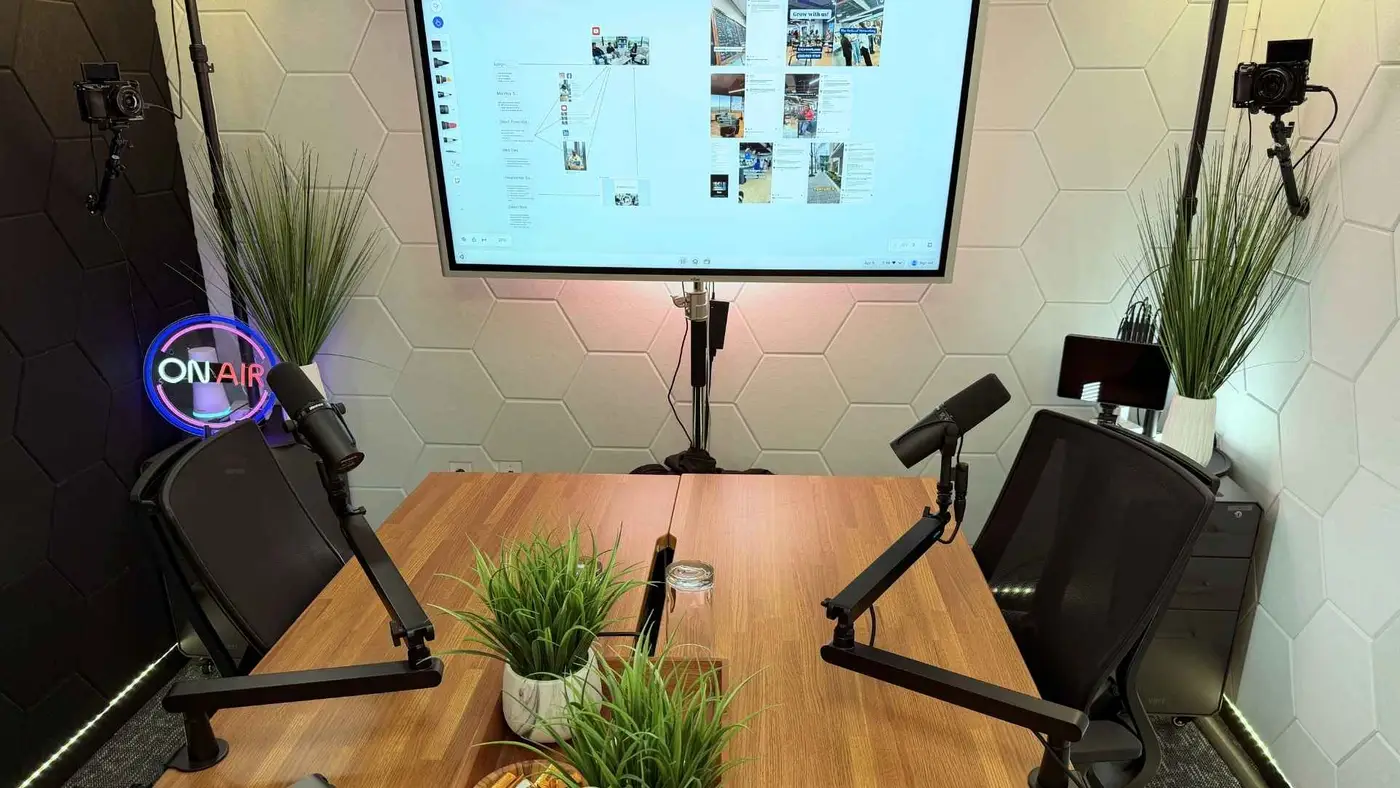
A room at I-10 and 410 with the gear already bought, already set, already rolling — Shure SM7B microphones into a RØDEcaster Pro II, Sony Alpha 6400 4K cameras, a professional teleprompter, and acoustic treatment that is already done arguing with your voice.
Then the part most shows never get to. The edit, the clips, the written page, the scheduling — handled, so an hour in the studio turns into a month of content instead of a file sitting on a drive.
— Podcast Studio San Antonio, I-10 & 410