How to Launch a Podcast in San Antonio in 5 Steps
Most podcasts fail before episode ten, and almost never because of equipment. Here is the sequence that avoids the usual reasons.
Step 1: What is your show actually about?
Pick a subject narrow enough that you could list twenty episode titles right now. "Business in San Antonio" is not a show. "How San Antonio contractors win commercial bids" is a show, and the difference is that the second one tells a listener whether this is for them.
The most reliable source of topics is your own sales conversations. Every question you answer repeatedly is an episode, and it is pre-validated — you already know real buyers care, because they keep asking.
Write the list of twenty before you go further. If you cannot get past eight, the topic is too narrow or you are not close enough to the audience yet.
Step 2: What format and cadence can you sustain?
Choose between solo, interview, or co-hosted, and be honest about which one you will still want to do in month seven. Solo is the hardest to sustain and the easiest to schedule. Interviews are easier to fill but require booking guests continuously.
Cadence matters more than length. Every two weeks, held for a year, beats weekly for six weeks followed by silence. Pick the schedule that survives your busiest month, not your calmest one.
Decide on video now rather than later. Recording video and stripping the audio out is easy; recovering video you never captured is impossible.
Step 3: Where should you record in San Antonio?
Your options are a treated space at home or office, a rented studio, or an untreated room — and the third is the one to avoid. Echo and room hollowness are the fastest way to sound amateur, and they are largely unfixable in post.
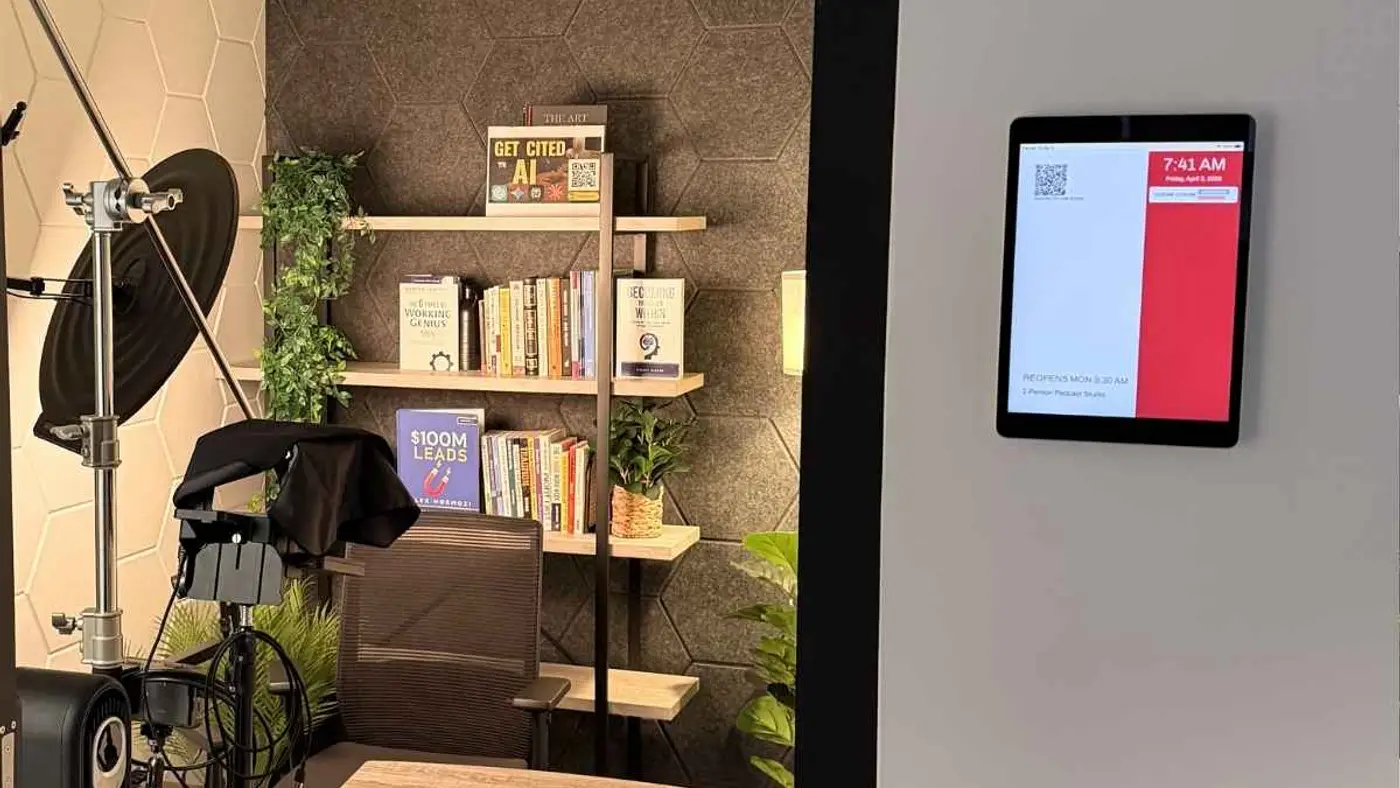
If you are recording interviews or video, a studio removes most of the failure modes at once. At Podcast Studio San Antonio the solo and four-person rooms run Shure SM7B microphones into a RODECaster Pro II with Sony Alpha 6400 cameras and a teleprompter, in a space that is already treated.
If you are recording solo audio frequently, treating a small room at home is a reasonable investment. Just treat it properly — soft surfaces on the reflection points, not a single foam square behind the mic.
Step 4: How do you actually publish it?
You need a podcast host — the service that stores your audio and generates the RSS feed that Spotify, Apple Podcasts, and the rest read. You cannot upload episodes to those platforms directly; they all pull from your feed.
You will need cover art (3000x3000 pixels), a show description, and a category. Get the artwork right, because at thumbnail size it is the only thing distinguishing you from everyone else in the category.
Then publish each episode on your own website as a real page — title, summary, transcript, and the embedded player. This is the step almost everyone skips, and it is the one that makes the episode findable by search engines and quotable by AI assistants.
| Asset | Requirement | Why it matters |
|---|---|---|
| Cover art | 3000x3000 px, square | Legible at thumbnail size is the only test |
| Show description | Under 4,000 characters | Where directory search finds you |
| Episode page | On your own site, with transcript | The only version Google and AI can read |
| RSS feed | From your podcast host | How every platform receives episodes |
Step 5: How do you keep it alive past episode ten?
Launch with a backlog. Record three episodes before publishing the first, and publish on a schedule that keeps at least one finished episode in reserve. The moment you are recording the episode that publishes tomorrow, the show is in trouble.
Batch your recording. Two or three episodes in one studio visit is barely harder than one, and it converts an ongoing weekly obligation into a monthly appointment.
Assign the post-production explicitly. Editing, clips, the written page, and scheduling all need an owner who is not the host. Podcasts rarely die from lack of ideas — they die because the host ran out of evenings.
What does a realistic first-month timeline look like?
Week one: choose the topic, write twenty episode titles, decide format and cadence. Week two: set up the podcast host, commission cover art, write the show description. Week three: record three episodes. Week four: edit, build the episode pages, and publish the first.
That is a month of part-time effort to a real launch, and it is deliberately unglamorous. Nothing in it requires buying equipment before you know the show will exist.
From there the ongoing commitment is one recording session and one planning block per month, provided the production work is handled.
How do you choose a name that will not limit you?
Pick something broad enough to survive a change of direction but specific enough to signal what the show is. Naming it after your current service offering is the most common trap, because the show outlives the offering.
Descriptive names generally outperform clever ones for business podcasts, because discovery happens through search and browsing rather than word of mouth. Someone scanning a list of shows needs to know what yours is in about two seconds.
Check availability before committing: the podcast directories, the domain, and the social handles. Renaming a show later means losing the accumulated directory history, which is a genuinely annoying cost.
What should the cover art actually look like?
It has to work at roughly the size of a postage stamp, because that is how it will mostly be seen. This single constraint eliminates most designs — detailed illustrations, long titles, and thin typefaces all disappear at thumbnail scale.
That means large type, high contrast, and at most a few words. If the show name is long, put the memorable part at large size and the rest small, or drop the rest entirely.
Include a face if the show is built around a person. Human faces are unusually effective at stopping a scroll, and for an authority-driven business podcast the host is the brand anyway.
How should you structure an individual episode?
Open with the question the episode answers, in one sentence, within the first fifteen seconds. No music bed, no introduction, no housekeeping. Someone deciding whether to stay needs to know immediately what they are getting.
Then give a short version of the answer before the long version. This feels counterintuitive — you are giving away the conclusion — but it dramatically improves retention, because listeners stay for the reasoning once they know it is relevant to them.
Close by naming what you covered and what to do next. A clear, single call to action beats three competing ones, and the ending is the moment when a listener who found the episode useful is most likely to act.
| Segment | Length | Purpose |
|---|---|---|
| The question | 0:00–0:15 | Tell them what this is |
| The short answer | 0:15–1:30 | Prove relevance immediately |
| The reasoning | Bulk of the episode | Where the value lives |
| Recap + one CTA | Final 60–90 sec | Convert the attention |
What are the most common launch mistakes?
Launching with one episode is the biggest. A listener who likes it has nowhere to go, and the show reads as an experiment rather than a commitment. Two or three at launch solves this entirely.
The second is naming episodes by number rather than by topic. "Episode 7" is invisible to search and tells a browsing listener nothing. Descriptive titles are how episodes get found years later.
The third is skipping the episode page on your own site. Publishing only to Spotify and Apple means the content exists in a format search engines and AI assistants cannot read, which forfeits most of the long-term value.
What should you do in the first 90 days after launch?
Hold the cadence above all else. The first three months are where the habit forms — both yours and your audience's — and a missed slot in month two does more damage than a mediocre episode.
Tell people directly. Email your client list, mention it in meetings, add it to your signature, and ask a handful of people whose opinion you trust to listen and tell you what is not working. Organic discovery in the first quarter is close to zero for every show.
Start collecting questions from real conversations immediately. By month three you should have a running list long enough that planning an episode takes ten minutes rather than an hour.
And resist redesigning. New podcasters commonly change the name, artwork, or format twice in the first quarter, which resets whatever recognition has accumulated. Give the original decision at least ten episodes before judging it.
Frequently Asked Questions
How much does it cost to start a podcast in San Antonio?
Podcast hosting runs roughly $12 to $25 a month and cover art is a one-time cost. Beyond that, the variable is recording: a treated home setup is several hundred to a few thousand up front, while studio sessions are a per-booking fee with no equipment cost.
How long should episodes be?
Long enough to answer the question properly and no longer. Most business podcasts land between 20 and 45 minutes. Do not pad to hit a target length — listeners notice, and a tight 18-minute episode outperforms a loose 50-minute one.
Do I need to be on every platform?
Spotify, Apple Podcasts, and YouTube cover the overwhelming majority of listening. Your podcast host will distribute to the smaller directories automatically, so there is no real cost to being listed everywhere — just do not spend effort optimizing for the long tail.
Should I publish all episodes at launch or space them out?
Publish two or three at launch so a new listener who likes the first has somewhere to go, then move to your regular cadence. Releasing ten at once wastes momentum you cannot get back.
Do I need a transcript for every episode?
Yes, if you want the episode to be findable. Transcripts are what search engines index and what AI assistants quote. They also make the episode accessible to deaf and hard-of-hearing audiences, which is reason enough on its own.
Should I buy a domain for the podcast?
Usually not a separate one. Host episodes on your existing business site under a /podcast or /blog path so the content builds authority for the domain you actually want ranking. A separate domain splits your SEO effort.
How do I get my podcast on Spotify and Apple?
Submit your RSS feed once through your podcast host, and both platforms pull new episodes automatically from then on. Approval usually takes a few days for the first submission.
What if my first episodes are bad?
They will be, and that is normal. Record three before publishing, launch with the strongest, and know that you can always re-record and replace an early episode later once you have found the format.
Should I promote the podcast to my email list?
Yes, and more than once. Your existing list is the highest-converting audience you have — they already know you. A single announcement reaches a fraction of them; mentioning new episodes regularly reaches far more.
How do I get my first guests with no audience?
Start with people who already know you — clients, partners, vendors, peers. They are saying yes to you rather than to your download numbers, and each appearance gives you something to show the next guest you approach.
You bring the conversation. We handle everything after.
A room at I-10 and 410 with the gear already bought, already set, already rolling — Shure SM7B microphones into a RØDEcaster Pro II, Sony Alpha 6400 4K cameras, a professional teleprompter, and acoustic treatment that is already done arguing with your voice.
Then the part most shows never get to. The edit, the clips, the written page, the scheduling — handled, so an hour in the studio turns into a month of content instead of a file sitting on a drive.
— Podcast Studio San Antonio, I-10 & 410