Why Established Leaders Are Moving to Video Podcasts
The people with the most to lose from looking unpolished are the ones moving fastest into long-form video. That is worth paying attention to.
Why are established figures choosing long-form over short?
Because long-form is the only format where trust actually compounds. A thirty-second clip can make someone curious. An hour of unedited thinking is what makes them believe you know what you are talking about — and it is very difficult to sustain for an hour if you do not.
There is also a control argument. An interview on someone else's show is edited by someone else, framed by their agenda, and lives on their channel. A recurring show you own accumulates into an archive that belongs to you.
For anyone whose reputation is the product — consultants, attorneys, financial advisers, agency owners, physicians — that archive is the asset.
Does this work for a business without a national audience?
It works better, because the bar is different. A national show needs scale to be worth making. A local business podcast needs roughly forty of the right people to watch it — the ones already deciding whether to hire you.
The metric is not downloads. It is whether the sales conversation gets shorter and warmer. When a prospect arrives having watched two episodes, you skip the credibility phase entirely and start at the real conversation.
That is a measurable business outcome even if the public numbers stay modest, and it is the reason a San Antonio business should judge a podcast by close rate rather than chart position.
What actually makes a leader's podcast credible?
Specificity. Naming real numbers, real constraints, and real mistakes is what separates a credible show from a brochure read aloud. Audiences are extremely good at detecting when someone is being careful rather than honest.
Consistency is the second half. A show that appears twice and stops reads as abandoned, which is worse than never starting. A steady twice-monthly cadence signals that the business is stable and organized — an inference people make without noticing.
Production quality plays a supporting role. It cannot make weak thinking credible, but poor audio can make strong thinking sound amateur, which is a genuinely unfair way to lose.
How much time does a serious show actually take?
Less than most executives assume, if the work after the recording is handled by someone else. The recording itself is about an hour. Planning is maybe thirty minutes if you are talking about your own field.
The heavy part — editing, clipping, writing the companion article, scheduling the posts — is where the hours hide, and it is entirely delegable. It is also the part that determines whether the episode produces anything.
A practical rhythm for a busy principal: batch two or three episodes in a single studio visit every month, then step away entirely. Two hours a month sustains a serious show.
| Task | Time | Who does it |
|---|---|---|
| Planning the episode | ~30 min | You |
| Recording | ~60 min | You, in the studio |
| Editing + color + audio | 2–4 hrs | Production team |
| Clips + written article | 2–3 hrs | Production team |
| Scheduling + distribution | 1 hr | Production team |
What format works best for a business leader?
Interview-led shows are the most durable. Hosting means you do not have to generate every idea yourself, your guests bring their own audiences, and the format gives you a legitimate reason to build relationships with people worth knowing in San Antonio.
Solo explainer episodes work well alongside it, particularly for questions you answer constantly in sales conversations. These become the pages that rank and get cited.
What tends not to work is the unstructured company update. If the episode would not be interesting to someone who has never heard of your business, it will not be interesting to your prospects either.
How do you start without embarrassing yourself?
Record three episodes before publishing any of them. The first will be stiff, the second will be better, and by the third you will sound like yourself. Publish starting with the third and quietly release the first later, or never.
Use a teleprompter for the open and close only. Scripting the whole episode makes you sound like you are reading, but an unscripted opening is where most people ramble for four minutes.
Book a room where the technical side is not your responsibility. Worrying about levels while trying to think clearly is what makes people sound nervous on their own show.
What separates an authority show from a marketing show?
An authority show is willing to say things that are useful even when they do not lead to a sale. A marketing show routes every topic back to the product, and audiences detect the difference within one episode.
The counterintuitive part is that the authority show sells better. Being genuinely useful about the parts of the problem you do not charge for is what makes people believe you about the parts you do. Withholding the useful material to protect the pitch tends to produce a show nobody finishes.
A practical test: would this episode be worth someone's time if they were never going to hire you? If the answer is no, the episode is an advertisement and will perform like one.
How do you handle topics where you might be wrong?
Say so explicitly. "Here is how I think about this, and here is where I could be wrong" is one of the most credibility-building sentences available to a business owner, and almost nobody uses it.
Certainty is cheap and audiences know it. Calibrated confidence — being clear about what you know cold, what you believe, and what you are still working out — is what distinguishes an expert from a marketer.
This also protects you. Stating something as certain that later turns out to be wrong is a real reputational cost when it is sitting in a permanent archive with your name on it.
What should a leader avoid talking about?
Anything involving a specific client without their explicit permission, anything touching live litigation or a live negotiation, and anything about staff. These seem obvious and are still the most common ways business podcasts create problems.
Also avoid competitor commentary. It reads as insecurity, it dates badly, and it is permanently attached to your name in a searchable archive. Describing your own approach is more persuasive than critiquing someone else's.
Financial specifics deserve care. Talking about pricing structures and economics generally is useful and differentiating. Naming actual client figures is a confidentiality problem waiting to happen.
How does a show change the sales conversation?
It moves the credibility work earlier. In a normal sales call, the first third is spent establishing that you know what you are doing. When a prospect has watched two episodes, that third disappears and the conversation starts at scope and fit.
It also filters. People who watch several episodes and then reach out have effectively pre-qualified themselves on approach and philosophy, which means fewer conversations that were never going to work.
The measurable version: shorter sales cycles, higher close rates on inbound, and less price resistance — because the perceived expertise arrived before the quote did.
| Stage | Without a show | With a show |
|---|---|---|
| First contact | Cold, credibility unproven | Already familiar with your thinking |
| Discovery call | A third spent proving competence | Starts at scope and fit |
| Objections | "Why you?" | Mostly timing and budget |
| Price resistance | Higher | Lower — expertise established |
What does the first year of a leader's show look like?
The first quarter is about finding the format. Expect the first several episodes to feel effortful and slightly wrong, and expect to change the structure at least once. This is normal and it is why recording ahead of publishing matters so much.
The second quarter is where the rhythm appears. Guest booking gets easier because you have episodes to point at, your own delivery relaxes, and the production workflow stops needing active management.
By the third quarter the archive starts working without you. Prospects arrive having watched something, episode pages begin surfacing in search, and guests start approaching you rather than the reverse.
The fourth quarter is where most of the compounding value shows up — and it is well past the point where most shows quit. The businesses that reach it face very little local competition, precisely because reaching it is the hard part.
How do you choose topics that build authority rather than traffic?
Pick the questions that only someone doing the work could answer. Anyone can publish a general overview; very few people can explain what actually goes wrong at step four, and that specificity is what reads as genuine expertise.
Favour the decisions your buyers find hardest. The topics with the most commercial value are rarely the ones with the most search volume — they are the ones a prospect is genuinely stuck on right before they hire someone.
Be willing to publish the uncomfortable answer. Explaining when someone should not hire you, or when the cheaper option is the right one, buys more credibility than any amount of positioning.
And revisit topics as your view changes. An episode saying "I said this two years ago and I now think differently" is one of the strongest authority signals available, because almost nobody is willing to make it.
Frequently Asked Questions
How many episodes before a podcast shows results?
For local business outcomes, results often appear well before public traction — sometimes within the first few episodes, because prospects start watching before they ever contact you. Meaningful search and audience traction typically takes six months of consistent publishing.
Should executives host or be a guest on other shows?
Both, but hosting compounds. Guest appearances build reach on borrowed platforms; hosting builds an archive you own. Most leaders benefit from hosting a recurring show and guesting selectively on shows that reach their buyers.
Is video necessary, or is audio enough?
Video is strongly preferable for authority-building. Seeing someone think, hesitate, and answer carefully is far more persuasive than hearing it, and video unlocks YouTube plus vertical clips while still giving you the audio version.
What if I am not naturally charismatic on camera?
Charisma matters much less than clarity in long-form. Audiences watching an hour-long episode are there for substance. Being organized, specific, and honest outperforms being entertaining for business-focused shows.
How do I find guests worth interviewing?
Start with people you already know professionally — clients, partners, vendors, and peers in adjacent fields. A local show has a natural advantage here because a San Antonio business owner is far more likely to say yes to a neighbor than to a stranger.
What if a competitor starts a podcast too?
It generally helps both of you. Two shows in a local category build the category's audience, and the market is rarely so small that only one can work. The differentiator is consistency and specificity, not exclusivity.
Should I let guests promote their own business?
Yes, within reason. Guests who get something out of the appearance say yes more readily and share the episode with their own network. A brief, genuine mention costs you nothing and buys real goodwill.
How do I keep a leadership podcast from becoming self-indulgent?
Anchor every episode to a question your audience actually asks. The moment the show becomes about your journey rather than their problem, retention falls. Personal stories work best as illustrations, not as the subject.
How much should a leader delegate versus do personally?
Do the thinking and the talking; delegate everything else. The host must own topic selection and the conversation itself, because that is the part that cannot be outsourced. Editing, clipping, writing, and scheduling should not touch the principal's calendar.
What if I have to pause the show for a busy quarter?
Build a backlog rather than pausing. Batching three episodes in one session creates a buffer that covers a busy stretch without a visible gap. An unexplained silence reads as abandonment, which is worse than a slower cadence.
You bring the conversation. We handle everything after.
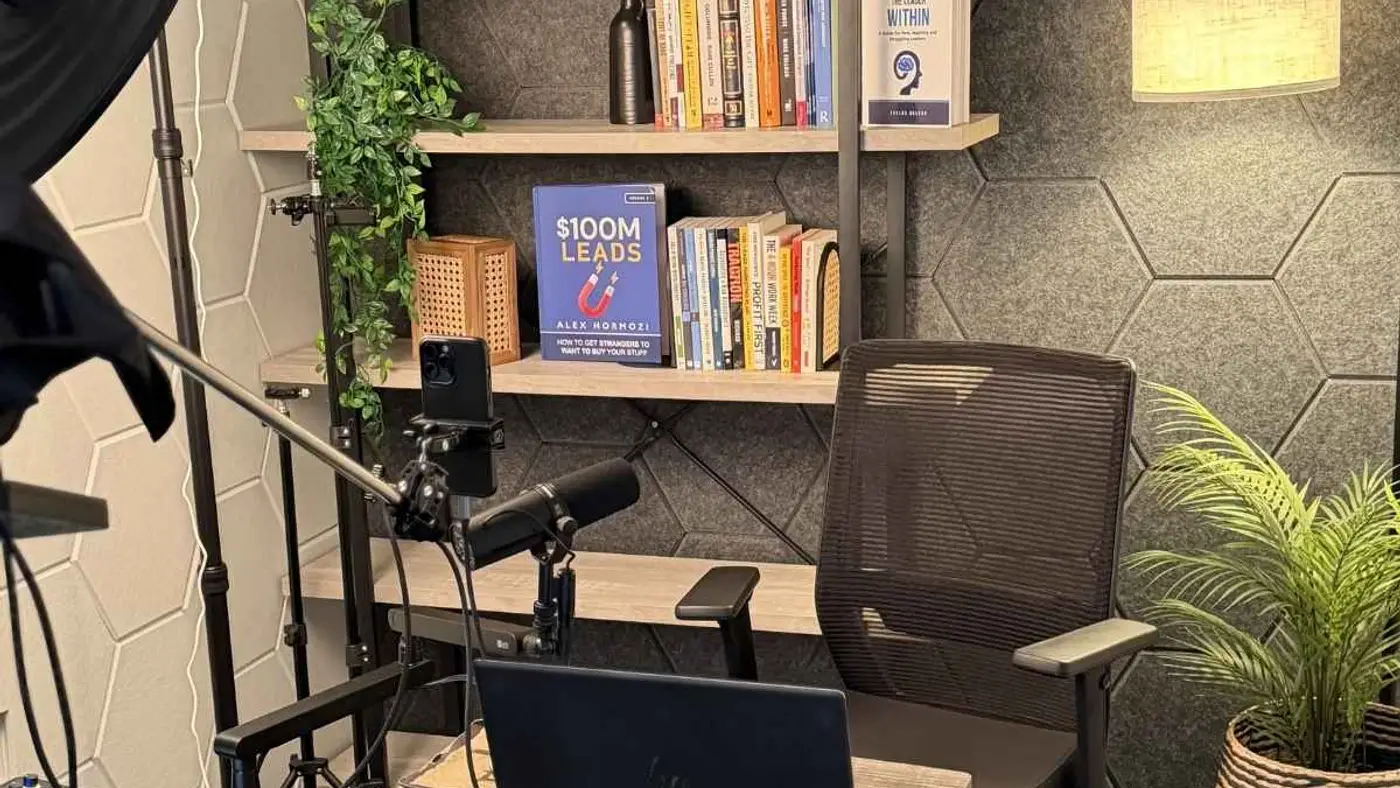
A room at I-10 and 410 with the gear already bought, already set, already rolling — Shure SM7B microphones into a RØDEcaster Pro II, Sony Alpha 6400 4K cameras, a professional teleprompter, and acoustic treatment that is already done arguing with your voice.
Then the part most shows never get to. The edit, the clips, the written page, the scheduling — handled, so an hour in the studio turns into a month of content instead of a file sitting on a drive.
— Podcast Studio San Antonio, I-10 & 410