DIY Podcasting vs. Studio Rental in San Antonio
DIY is genuinely the right answer for some shows. Here is how to tell whether yours is one of them, without the sales pitch.
What does a DIY podcast setup really cost?
A credible home setup runs roughly $700 to $2,500 before you record a single minute, and that is the honest range — not the $99 USB microphone version, which sounds like a $99 USB microphone.
The number people forget is acoustic treatment. A quiet room is not a treated room. Bare walls, hard floors, and glass create reflections that no amount of post-processing fully removes. Real treatment for a small room adds a few hundred dollars and has to stay up permanently, which is a harder sell in a spare bedroom than it sounds.
Then there is the recurring cost that never appears on the receipt: your hours. Setup, teardown, troubleshooting, and editing add up quickly, and they recur every single episode.
| Cost | DIY at home | Studio session |
|---|---|---|
| Up-front equipment | $700–$2,500 | $0 |
| Acoustic treatment | $200–$800, permanent install | Already built in |
| Setup + teardown per episode | 30–60 minutes | 0 minutes |
| Editing per episode | 2–4 hours, or outsourced | Handled |
| Multi-camera video | Significant added cost + sync work | Already rigged |
| Cost per episode | Low once amortized | Per-session fee |
When is DIY genuinely the better choice?
DIY wins when you publish often, record solo, and stay audio-only. If you are shipping two or three episodes a week from a desk, the per-session economics of a studio stop making sense and a treated corner of your home pays for itself fast.
It also wins when spontaneity matters more than polish. Some shows are better because they were recorded at 11pm the moment the idea landed. Booking a room kills that.
And it wins if you actually enjoy the technical side. Some people find mixing genuinely satisfying. If that is you, the learning curve is a feature rather than a cost.
When does a studio clearly win?
A studio wins the moment you add a second person in the room. Multi-person audio means multiple isolated microphone channels, and multi-person video means multiple angles that have to stay in sync. Both are solvable at home and both are genuinely annoying.
It also wins when the recording is client-facing. If you are interviewing a guest whose time you are asking for, or filming something a prospect will judge you by, the room itself becomes part of the pitch. Asking a CEO to sit on a stool in your garage costs you something.
And it wins on consistency. A studio sounds identical in March and in November. Home setups drift — a rug moves, a window opens, a neighbor renovates — and the back catalog stops matching.
How much does sound quality actually matter?
More than video quality, and it is not close. Audiences tolerate a soft image and abandon bad audio within seconds. Echo, room hollowness, and inconsistent levels read as unprofessional even to listeners who could not name what is wrong.
On short-form platforms this compounds. Clips are watched at full volume on phone speakers in noisy places. Thin, reverberant audio simply does not survive that, and the platform responds to early drop-off by showing the clip to fewer people.
The practical implication: if you go DIY, spend on the room before you spend on the microphone. A modest mic in a treated space beats an expensive mic in an untreated one every time.
What does a San Antonio studio session actually include?
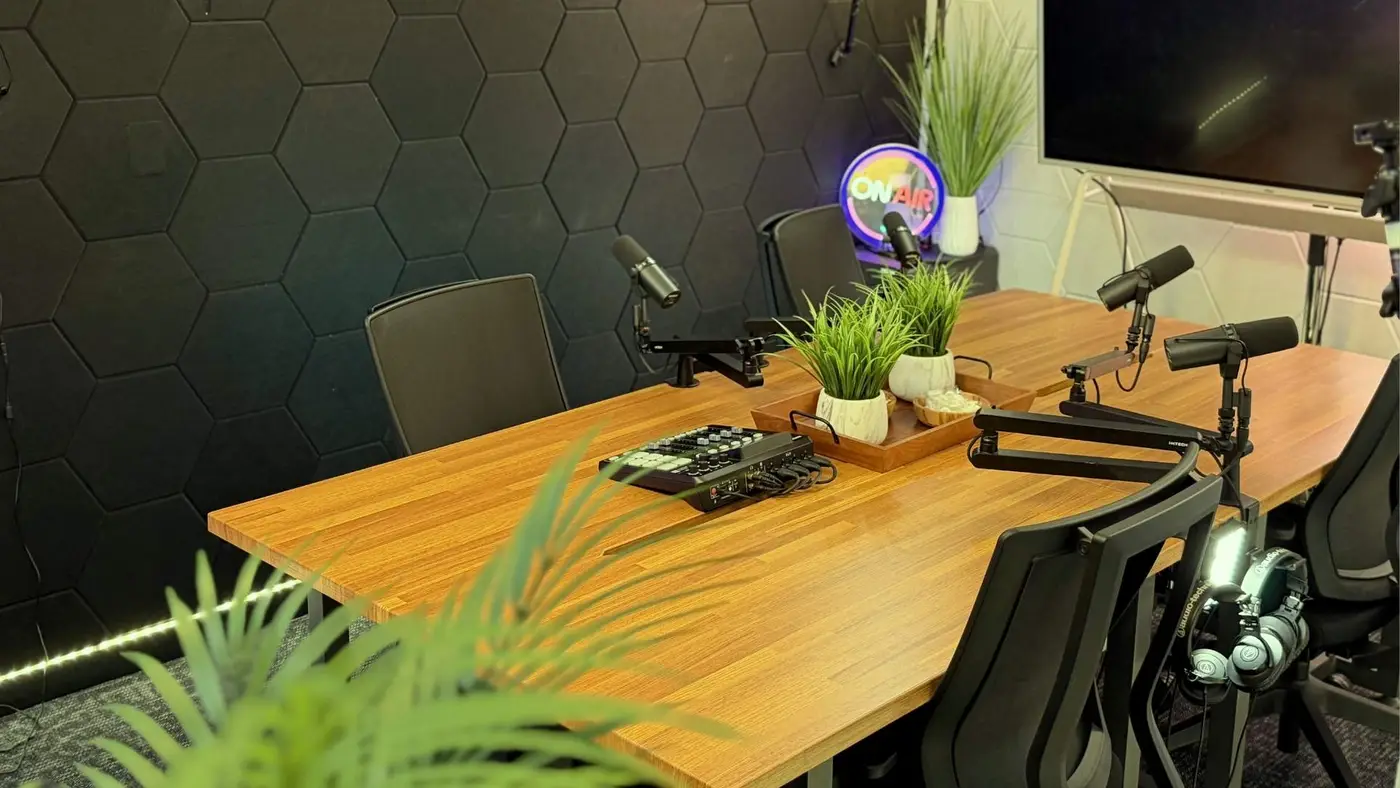
At Podcast Studio San Antonio there are two configurations — a solo studio and a four-person studio — running Shure SM7B microphones into a RODECaster Pro II, with Sony Alpha 6400 cameras for 4K video, a professional teleprompter, and acoustic treatment already in place.
The practical difference is that none of it is your problem. You arrive, sit down, and talk. Levels are set, the room is treated, the cameras are framed and rolling, and the files are handled afterward.
The studio is also paired with post-production and distribution, which is the part that matters most. Recording is an hour. Turning that hour into an episode, a set of clips, and a written page is the work that actually produces results.
Can you start DIY and move to a studio later?
Yes, and it is a sensible path. Prove the show exists first. Record a few episodes at home, confirm you will actually keep doing it, and learn what your format wants to be. Most podcasts end before episode ten, and it is better to discover that cheaply.
The awkward part is the audible jump in quality mid-catalog. You can smooth it by keeping the same microphone type and by re-recording your intro once you move, so the front of every episode is consistent.
A middle path works well too: record routine solo episodes at home and book a studio for interviews, guest episodes, and anything with video. Many shows settle there permanently.
How do you treat a room properly if you go DIY?
Start with the first reflection points — the spots on the walls to your left and right where sound bounces from your mouth to the microphone. Covering those two areas does more than covering the entire rest of the room.
Then handle the floor and the ceiling. A hard floor under a hard ceiling creates a parallel surface pair that produces flutter echo, the metallic ringing you hear when you clap in an empty room. A rug solves the floor; the ceiling usually needs something soft directly above the recording position.
Corners matter more than people expect, because low frequencies accumulate there and produce the boomy quality that makes voices sound muddy. Soft, thick material in the corners behind you is worth more than thin foam spread evenly across a wall.
The cheap version of all of this is a room with a bed, curtains, a rug, and a bookshelf. The expensive version is purpose-built panels. The difference between them is smaller than the difference between either one and a bare room.
What are the hidden costs people miss on both sides?
On the DIY side, the hidden cost is almost always time, and it recurs forever. Two to four hours of editing per episode across twenty-four episodes a year is somewhere between fifty and a hundred hours — an entire working fortnight spent on post-production.
The second DIY cost is opportunity: the episodes you do not record because setting up was inconvenient. Friction quietly reduces output, and output is what makes podcasting work.
On the studio side, the hidden cost is scheduling. You record when the room is available, not when inspiration strikes, which makes batching essential rather than optional. Businesses that book monthly and record three episodes at a time barely notice this; businesses that book ad hoc find it genuinely constraining.
| Hidden cost | DIY | Studio |
|---|---|---|
| Editing hours per year | 50–100 | Handled |
| Episodes lost to setup friction | Real and unmeasured | None |
| Scheduling constraint | None | Book ahead, batch sessions |
| Quality drift over time | Common | None |
| Guest experience | Variable | Consistent and professional |
Does the choice change once you add a guest?
Substantially, and this is the threshold most shows underestimate. Two people in a room means two microphones on separate channels, two sets of headphones, and — if you are shooting video — at least two camera angles that stay synchronised.
It also changes the social contract. When you ask someone to give you an hour, the environment communicates how seriously you are taking their time. A treated room with cameras already framed reads very differently from a kitchen table with a laptop.
For interview-led shows, this alone often settles the question. The show depends on guests saying yes, and guests say yes more readily when the ask looks professional.
What is the honest recommendation?
If you are publishing solo audio two or more times a week, treat a room at home. The economics are decisive and the flexibility genuinely matters at that frequency.
If you are publishing video, interviewing guests, or producing anything a prospect will judge you by, book a studio. The failure modes you avoid — bad audio, mismatched angles, an awkward guest experience — are the ones that quietly kill shows.
If you are somewhere in between, which most local businesses are, the hybrid works: a treated corner at home for quick solo episodes, and a studio booking for interviews and anything with video. Many shows run this way permanently and it is a perfectly good answer.
What does the first year cost, honestly, either way?
Take a realistic case: twenty-four episodes over twelve months, video included, published twice a month. That is enough volume to make the comparison meaningful rather than theoretical.
The DIY path front-loads equipment and back-loads time. You buy microphones, an interface, lights, a camera, and treatment, then spend somewhere between fifty and a hundred hours across the year on setup, teardown, and editing. If your time has any commercial value, that is the dominant cost and it does not appear on any invoice.
The studio path inverts it: no equipment cost, no editing hours, but a per-session fee twelve times over if you batch two episodes per visit. The cost is visible, predictable, and it stops when you stop.
Which is cheaper depends almost entirely on what an hour of your time is worth. For an owner-operator billing meaningful rates, the DIY path is usually more expensive once time is counted honestly — which is the calculation most people avoid doing.
Frequently Asked Questions
What is the minimum equipment for a decent DIY podcast?
A dynamic microphone with an audio interface or a mixer-recorder, closed-back headphones, a stable boom arm, and some acoustic treatment for the room. The treatment is the part people skip and the part that matters most for how professional you sound.
Is a studio worth it for a solo show?
It depends on frequency and format. For a weekly audio-only solo show, a treated home setup usually makes more economic sense. For a solo video show, or one where the visual presentation is part of the pitch, a studio is generally worth it.
How long does editing take if I do it myself?
Budget two to four hours per finished episode when you are starting out, including cleanup, levels, and cuts. That drops with experience but rarely below about ninety minutes for a well-produced hour-long episode.
Can I record video podcasts at home?
Yes, but it is a real step up in difficulty. Lighting, framing, background, and multi-camera sync all have to be solved simultaneously, and any one of them being wrong is visible immediately. This is where most home setups stop being worth the trouble.
Do I need a separate microphone for each guest?
Yes, for anything beyond a casual recording. Individual microphones on separate channels let each voice be balanced and cleaned independently. A single shared microphone picks up far more room noise and makes editing much harder.
How much acoustic treatment is enough?
Cover the first reflection points on both side walls, the floor, and ideally the ceiling above the recording position. If a hand clap in the room produces no audible ring, you are close enough for podcasting.
Can I use a closet as a recording booth?
A clothes-filled closet is genuinely one of the better free options, because hanging fabric absorbs well. The limitations are heat, space, and the fact that it does not work for video or for more than one person.
Does a studio make sense if I only publish monthly?
Often yes, because at that frequency DIY equipment never amortises. Booking one session a month and batching two or three episodes is usually cheaper than buying and maintaining a setup you use twelve times a year.
Does equipment hold its value if I stop podcasting?
Reasonably well. Quality dynamic microphones and interfaces have a strong used market and hold value better than cameras. That partially offsets the DIY risk if the show does not survive its first year.
Can I try a studio once before committing to equipment?
Yes, and it is the sensible order. One session tells you what properly treated audio and multi-angle video actually sound and look like, which is a far better basis for an equipment decision than reading specifications.
You bring the conversation. We handle everything after.
A room at I-10 and 410 with the gear already bought, already set, already rolling — Shure SM7B microphones into a RØDEcaster Pro II, Sony Alpha 6400 4K cameras, a professional teleprompter, and acoustic treatment that is already done arguing with your voice.
Then the part most shows never get to. The edit, the clips, the written page, the scheduling — handled, so an hour in the studio turns into a month of content instead of a file sitting on a drive.
— Podcast Studio San Antonio, I-10 & 410