The Podcast Edge Most San Antonio Businesses Miss
Recording the episode is the easy part. The edge is in what happens to it afterward — and that is exactly the step most local businesses skip.
What edge are most businesses actually missing?
The missing edge is repurposing. Most San Antonio businesses record an episode, publish it to Spotify and Apple, share it once, and move on. That treats a recording session as the finished product when it is really the raw material for a month of marketing.
Think about what one hour in a studio actually produces. You have a long-form conversation, but you also have four to twelve self-contained moments where someone said something genuinely useful. You have a transcript that can become a written article. You have quotes for social, questions for an FAQ page, and B-roll of your team looking competent and human.
Businesses that get results from podcasting are not recording more often than everyone else. They are extracting more from each session.
Why does audio alone underperform for local search?
Because search engines and AI assistants read text. A 45-minute audio file, sitting on a podcast host, is close to invisible to Google, ChatGPT, or Perplexity when someone asks a question your episode already answers.
The fix is not complicated: publish the episode as a page with a real transcript, a descriptive title, headings that match how people actually ask the question, and a short summary at the top. Now the same conversation is indexable, quotable, and citable.
This matters more every year. When someone asks an AI assistant for a recommendation in San Antonio, the assistant answers from text it can read. If your expertise only exists as audio, you are not in the running.
How much content should one recording session produce?
A single well-planned session should carry a month. Here is a realistic output from one booking, assuming you plan the episode with repurposing in mind rather than treating it as a free-form chat.
| Asset | From one session | Where it works |
|---|---|---|
| Long-form episode | 1 | Spotify, Apple Podcasts, YouTube |
| Short vertical clips | 6–12 | Instagram Reels, TikTok, YouTube Shorts |
| Written article + transcript | 1 | Your site — the part search and AI can read |
| Quote graphics / audiograms | 4–6 | LinkedIn, Instagram, Facebook |
| FAQ answers | 3–5 | Service pages, schema markup |
What makes a clip worth cutting?
A clip works when it stands completely on its own. Someone scrolling past has no idea who you are, what the episode is about, or what came before this moment — so the clip has to deliver a full thought in under a minute.
The best candidates are usually a specific answer to a specific question, a number or a concrete example, a short story with a turn in it, or a strong opinion you are willing to defend. What almost never works: introductions, pleasantries, or the first three minutes of anything.
This is easier when you plan for it. Before recording, write down the six questions you want to answer cleanly. Answer each one as if it were the only thing being recorded, then let the conversation wander afterward.
Does production quality actually change results?
It changes retention, which changes everything downstream. Listeners will forgive an average camera. They will not forgive audio that is hollow, echoey, or clipped — they leave within seconds, and short-form platforms respond to that by showing the clip to fewer people.
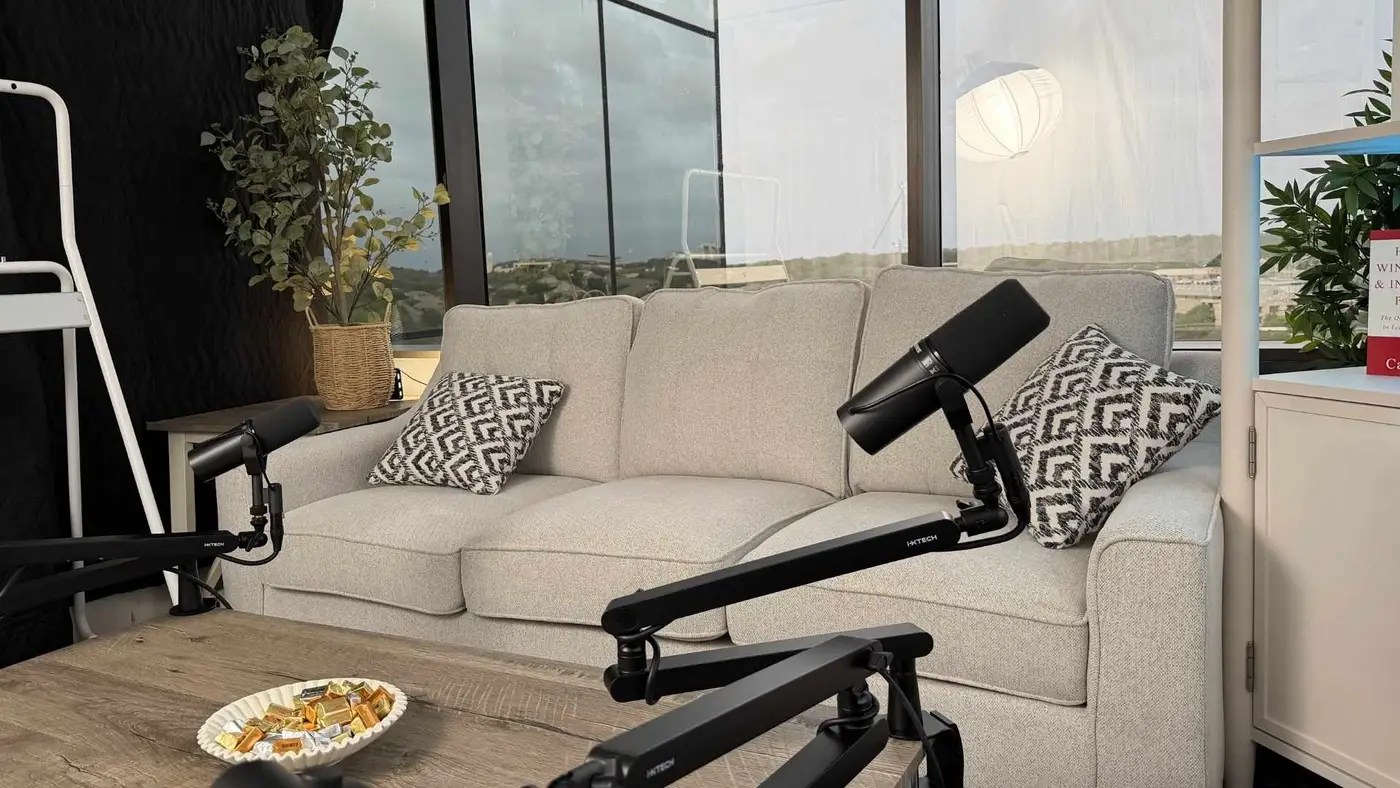
This is why acoustic treatment matters more than the microphone. A Shure SM7B in an untreated room still sounds like an untreated room. The same mic in a treated space, running into a RODECaster Pro II, sounds like a broadcast.
For video, multiple angles do more than higher resolution. Cutting between two or three camera angles keeps a talking-head clip visually alive, which is the difference between someone watching fifteen seconds and someone watching the whole thing.
How do you start without over-committing?
Book one session and plan six questions. Record the answers cleanly, then talk freely for another thirty minutes. That single hour gives you enough material to test whether podcasting earns its place in your marketing before you commit to a series.
Decide up front who handles the work after the recording ends — editing, clipping, the written version, and the posting schedule. This is the step where most local podcasts quietly die. If nobody owns it, it does not happen.
At Podcast Studio San Antonio the room is set up so recording takes an hour and everything after it is handled. That is the model worth copying whether you work with us or not: make the recording the easy part, and make sure the distribution is somebody's actual job.
What does a repurposing workflow actually look like?
The workflow is the same every month, which is what makes it survivable. Record, transcribe, mark the clip candidates, cut, write, schedule. Five steps, each one owned by a named person, running on a calendar rather than on enthusiasm.
Transcription comes first because everything else depends on it. Once the conversation is text, you can scan it in five minutes and mark the moments worth cutting, rather than scrubbing through an hour of video looking for them.
The written article is usually built from the transcript rather than written fresh. Take the structure of the conversation, tighten the language, add the headings you would have used if you had been writing rather than talking, and you have a page that took forty minutes instead of four hours.
The clips come last because they are the easiest step once the transcript is marked. What kills most repurposing efforts is trying to do this from memory, weeks later, without a transcript.
How do you decide what belongs on which platform?
Match the format to how people consume it rather than posting everything everywhere. The full episode belongs on YouTube and the podcast apps. Vertical clips belong on Instagram, TikTok, and YouTube Shorts. The written version belongs on your own site. LinkedIn takes native video and text posts.
The mistake is treating your website as a link hub that points at other platforms. Every link you post sends someone away from the page you control to a page you do not. The episode page on your own site should be a complete experience — the video embedded, the transcript readable, the summary at the top.
For a local business the priority order is usually your own site first, then YouTube, then LinkedIn, then the short-form platforms. That order reflects where purchase-intent attention lives, not where the most views are.
What does this look like over twelve months?
Twelve recording sessions produce roughly twenty-four episodes if you batch two per visit, and that yields something like 150 to 250 short clips, two dozen written pages, and a searchable archive answering most of the questions your buyers ask before they call.
The compounding is the point. Month one produces almost nothing measurable. Month six, you start noticing prospects referencing episodes. Month twelve, the archive is doing work continuously — pages ranking, clips circulating, AI assistants quoting text you published.
This is also why stopping at episode eight is so costly. Nearly all the value arrives after the point where most shows quit, which means the businesses that finish the first year face very little local competition.
| Month | What you have | What it does |
|---|---|---|
| 1–2 | 2–4 episodes, ~30 clips | Almost nothing measurable yet |
| 3–6 | 8–12 episodes, a growing archive | Prospects start arriving informed |
| 6–12 | 16–24 episodes, pages indexed | Search and AI begin surfacing you |
| 12+ | A searchable body of expertise | Compounds without new spend |
How do you know whether it is working?
Ask every new enquiry how they found you and record the answer somewhere consistent. For local businesses this simple habit outperforms most analytics, because the buying journey happens across channels that do not talk to each other.
Watch the sales conversation itself. The clearest early signal is not traffic — it is a prospect opening a call already knowing what you do, how you work, and what you charge for. That shortens the cycle and raises close rates before any dashboard reflects it.
Then watch the episode pages in Search Console. Individual pages ranking for specific questions is the compounding asset, and it usually shows up somewhere between months four and eight.
What does running this properly actually cost?
Budget in three buckets: the recording, the post-production, and the distribution. Businesses that only budget for the first one are the businesses whose podcasts quietly stop, because the other two land on someone who already has a job.
Recording is the smallest and most predictable cost — a studio session, or the amortised cost of a home setup. It is also the only one most people plan for.
Post-production is the largest recurring line, and it scales with how much you want out of each session. An edited episode alone is one level; an edited episode plus twelve captioned clips plus a written article is another.
Distribution is mostly time rather than money: scheduling posts, writing the copy above them, replying to comments. It is small per episode and it is the step that most often gets skipped, which is why so many well-produced episodes reach nobody.
Frequently Asked Questions
Do I need a large audience before podcasting is worth it?
No. For most local businesses a podcast is a sales and authority asset before it is an audience play. A prospect who watches you explain your work for ten minutes arrives to the first conversation already convinced. That has value at an audience of zero.
How often should a San Antonio business publish episodes?
Every two weeks is a realistic, sustainable cadence for most businesses, and it is far better than weekly for a month followed by silence. Consistency signals reliability to both platforms and people. Pick a schedule you can hold for a year.
Should the podcast be video or audio only?
Video, if you have the option. Video gives you YouTube as a search surface, vertical clips for social, and audio as a byproduct — you can always strip the audio out. Starting audio-only means the video does not exist and cannot be recovered later.
What should the first episode be about?
The question you answer most often in sales conversations. You already know the answer cold, it is already proven to matter to your buyers, and it gives you a page that ranks for something with genuine commercial intent.
How long does a recording session take?
Plan on about an hour in the room for a single episode, plus a few minutes to settle in. Batching two or three episodes in one visit is common and is usually the most efficient way to build a backlog.
Who should own the repurposing work?
Someone other than the host, ideally. Hosts who also edit, clip, write, and schedule tend to stop within a few months. Whether it is an internal marketing person or an outside production partner matters less than the fact that it is explicitly somebody's job.
How long should I commit before judging the results?
Twelve months. Most of the compounding happens after month six, and shows judged at the three-month mark are almost always judged as failures regardless of whether they were working.
Can I repurpose old episodes I already recorded?
Yes, if you recorded video. Transcribe the back catalogue, publish proper episode pages, and cut clips from the strongest moments. Audio-only back catalogue can still become written pages, which is worthwhile on its own.
Is it cheaper to hire in-house or outsource production?
For most local businesses, outsourcing is cheaper until you are publishing weekly. A part-time editor becomes economical at volume; below that you are paying for idle capacity and for someone to keep their skills current.
What is the minimum viable version of this?
One recording session a month, one edited episode, six clips, and one written page. That is enough to build the compounding archive without committing to a production schedule you cannot hold.
You bring the conversation. We handle everything after.
A room at I-10 and 410 with the gear already bought, already set, already rolling — Shure SM7B microphones into a RØDEcaster Pro II, Sony Alpha 6400 4K cameras, a professional teleprompter, and acoustic treatment that is already done arguing with your voice.
Then the part most shows never get to. The edit, the clips, the written page, the scheduling — handled, so an hour in the studio turns into a month of content instead of a file sitting on a drive.
— Podcast Studio San Antonio, I-10 & 410